
Third-party nutraceutical manufacturing costs in India typically range from Rs. 50,000 to Rs. 1,00,000+ per batch for production setup or basic tablet/capsule runs, with finished box/bottle unit prices varying from Rs. 22 to over Rs. 2,500 depending on the formulation and minimum order quantity (MOQ).
Understanding the cost of third-party nutraceutical manufacturing is essential for startups, healthcare brands, distributors, and established businesses planning to launch their own supplement range. From protein powders and multivitamin tablets to collagen capsules, herbal supplements, and immunity boosters, manufacturing expenses vary significantly depending on product composition, ingredient quality, dosage form, packaging, and production volume.
For instance, a basic vitamin or mineral supplement may require a relatively modest investment, while specialised formulations containing imported ingredients, patented compounds, or premium active ingredients can substantially increase production costs. Additional expenses may include product development, testing, labelling, bottles or jars, cartons, regulatory documentation, and transportation.
The minimum order quantity also plays a crucial role in determining the final cost per unit. Larger orders generally reduce per-unit manufacturing expenses, whereas smaller batches may involve higher costs. Therefore, businesses should evaluate their target market, budget, and expected sales before selecting a manufacturing partner.
In this blog, we will explore the estimated cost of third-party nutraceutical manufacturing in India, the major factors influencing pricing, and practical ways to optimise your investment without compromising product quality.
Cost of Third-Party Nutraceutical Manufacturing in India
Here is the complete information about the cost of Third-Party Nutraceutical Manufacturing in India:
1. What Is the Average Cost of Third-Party Nutraceutical Manufacturing?
The cost of third-party nutraceutical manufacturing depends on the type of supplement, its ingredients, packaging, and order quantity. Manufacturers offer different prices based on the product requirements and production volume. Here is an estimated cost breakdown for businesses planning to launch their own nutraceutical products.
| Product or Service | Estimated Cost |
| Basic tablet or capsule batch | Rs. 50,000 – Rs. 1,00,000+ |
| Vitamin and mineral supplements | Rs. 22 – Rs. 150 per unit |
| Herbal and Ayurvedic supplements | Rs. 40 – Rs. 250 per unit |
| Protein powders and nutritional blends | Rs. 150 – Rs. 800+ per unit |
| Premium nutraceutical formulations | Rs. 300 – Rs. 2,500+ per unit |
| Product testing and quality checks | Rs. 5,000 – Rs. 25,000+ |
| Custom formulation development | Rs. 10,000 – Rs. 50,000+ |
| Packaging and labelling | Rs. 5 – Rs. 50+ per unit |
Note: These are indicative estimates for planning purposes, not fixed market rates. Actual prices depend on the manufacturer, ingredients, batch size, packaging specifications, and testing requirements. Some costs may already be included in the quoted manufacturing price.
2. Factors That Affect Third-Party Nutraceutical Manufacturing Costs
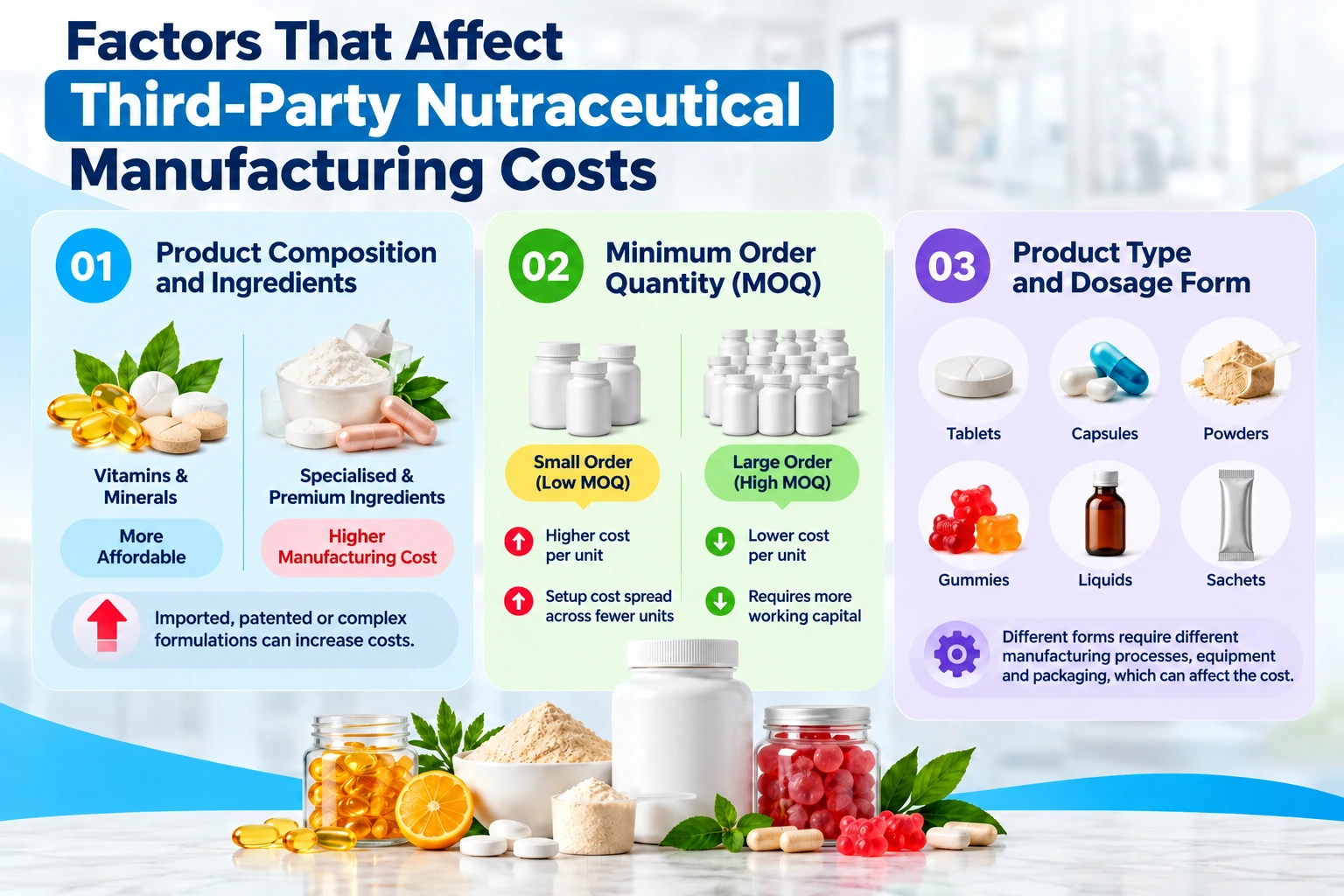
Several factors determine the final cost of manufacturing nutraceutical products. Understanding them can help businesses prepare a suitable budget.
Product Composition and Ingredients
The ingredients used in a supplement have a major impact on its manufacturing cost. Basic vitamins and minerals are often more affordable than specialised ingredients.
For example, a simple multivitamin tablet may cost less to manufacture than a collagen supplement containing premium ingredients. Products with imported raw materials, patented ingredients, or complex formulations may also require a higher investment.
Minimum Order Quantity (MOQ)
The minimum order quantity is the smallest number of units a manufacturer agrees to produce in one order. It directly affects the total investment and cost per unit.
A small order may have a higher cost per bottle because setup expenses are spread across fewer units. A larger order may reduce the cost per unit, but it requires more working capital.
Before placing an order, ask the manufacturer about its MOQ and whether it offers trial batches.
Product Type and Dosage Form
Nutraceutical products are available in several forms, including tablets, capsules, powders, gummies, liquids, and sachets.
Each form requires different manufacturing processes, equipment, and packaging materials. For example, powder supplements may need jars or pouches, while capsules usually require blister packs or bottles. These differences can change the final manufacturing price.
Packaging and Branding
Packaging is another important part of the overall budget. The cost depends on the type of bottle, container, label, carton, and seal used for the product.
Basic packaging is generally more economical. Premium bottles, customised cartons, special finishes, and attractive labels can increase the cost. Businesses should choose packaging that protects product quality and suits their target customers without increasing expenses unnecessarily.
3. Example: Calculate the Cost of a Nutraceutical Manufacturing Order
Let’s understand the estimated investment with a simple example.
Suppose you want to launch a vitamin supplement with an order quantity of 2,000 bottles.
| Expense | Estimated Amount |
| Manufacturing cost at Rs. 35 per bottle | Rs. 70,000 |
| Packaging and labelling at Rs. 10 per bottle | Rs. 20,000 |
| Product testing and documentation | Rs. 10,000 |
| Transportation and other expenses | Rs. 5,000 |
| Total estimated investment | Rs. 1,05,000 |
In this example, the estimated cost is Rs. 1,05,000 for 2,000 bottles. This brings the total cost to approximately Rs. 52.50 per bottle.
This calculation is only an example. Actual costs may be lower or higher depending on the formulation, packaging, and manufacturer’s quotation. Also, check whether the quoted manufacturing rate already includes packaging to avoid counting the same expense twice.
4. How to Reduce Third-Party Nutraceutical Manufacturing Costs
Businesses can manage their manufacturing budget by making informed decisions before placing an order.
Start with a suitable MOQ – Choose an order quantity that matches your budget and expected demand. Avoid ordering more stock than you can sell.
Compare multiple manufacturers – Request quotations from at least three manufacturers. Compare product specifications, packaging, quality standards, and delivery timelines instead of choosing only the lowest price.
Choose ingredients carefully – Select ingredients according to your product’s purpose and target market. Expensive ingredients should have a clear reason for inclusion.
Use practical packaging – Standard bottles, jars, and cartons may help reduce expenses compared with fully customised packaging.
Plan your product range – Launch a small number of products first. You can expand the range after understanding customer demand.
Check all additional charges – Ask whether the quotation includes testing, labelling, packaging, taxes, and transportation.
These steps can help businesses control costs while maintaining product quality and customer trust.
5. How to Choose the Right Third-Party Nutraceutical Manufacturer
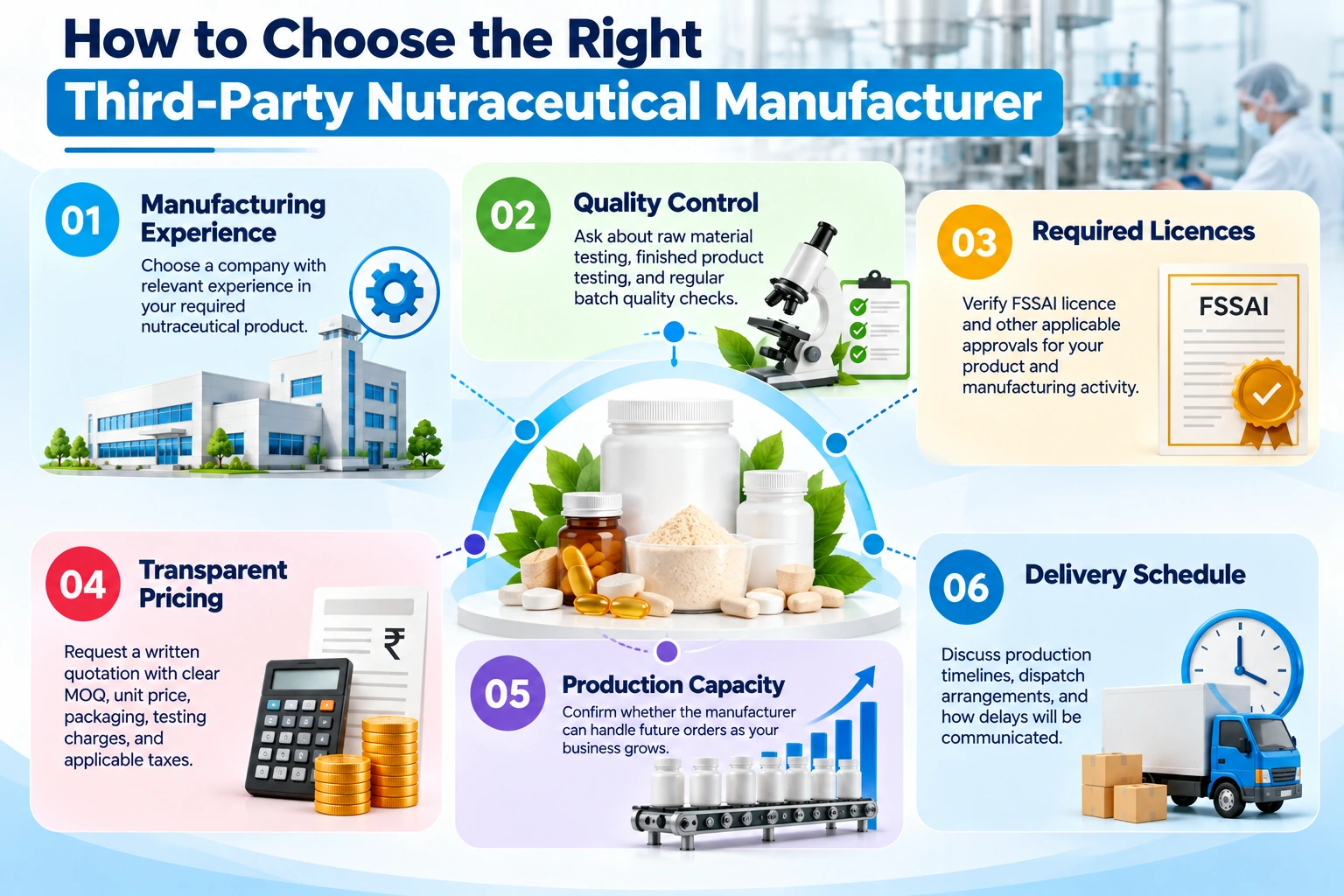
Selecting the right manufacturing partner is just as important as calculating the cost. A low quotation may not always offer the best value if quality, documentation, or delivery standards are inadequate. Before finalising a manufacturer, consider the following points:
- Manufacturing experience
Check whether the company has experience producing your required nutraceutical product.
- Quality control
Ask about raw material testing, finished product testing, and batch quality checks.
- Required licences
Verify the applicable FSSAI licence and other relevant approvals for the product and manufacturing activity.
- Transparent pricing
Request a written quotation that clearly lists the MOQ, unit price, packaging, testing charges, and applicable taxes.
- Production capacity
Confirm whether the manufacturer can handle future orders as your business grows.
- Delivery schedule
Discuss production timelines, dispatch arrangements, and how delays will be communicated.
You should also request product samples, where available, and review the manufacturer’s documentation before making a large investment.
Click Here! to learn about how to choose the right third-party nutraceutical manufacturer.
6. Is Third-Party Nutraceutical Manufacturing Profitable?
Third-party nutraceutical manufacturing can be a practical business model because you do not need to establish your own production facility. Instead, you can work with an existing manufacturer and focus on branding, marketing, distribution, and sales.
However, profitability depends on more than the manufacturing price. Businesses must also consider marketing expenses, distributor margins, shipping, taxes, product returns, and other operating costs.
For example, if the total cost of a supplement bottle is Rs. 100 and its selling price is Rs. 180, the difference is Rs. 80 per bottle before other selling and operating expenses. This amount should not be treated as net profit.
A proper cost calculation helps you set realistic prices, manage cash flow, and build a sustainable nutraceutical brand.
Conclusion
The cost of third-party nutraceutical manufacturing in India can vary from a basic investment of around Rs. 50,000 – Rs. 1,00,000+ per batch to considerably higher amounts for specialised formulations and larger production orders. The final price depends on ingredients, dosage form, MOQ, packaging, testing, and branding requirements.
Before choosing a manufacturer, compare quotations, verify the required licences, and calculate the complete cost per unit. Careful planning will help you launch your nutraceutical products with a suitable budget while maintaining quality and meeting customer expectations.
